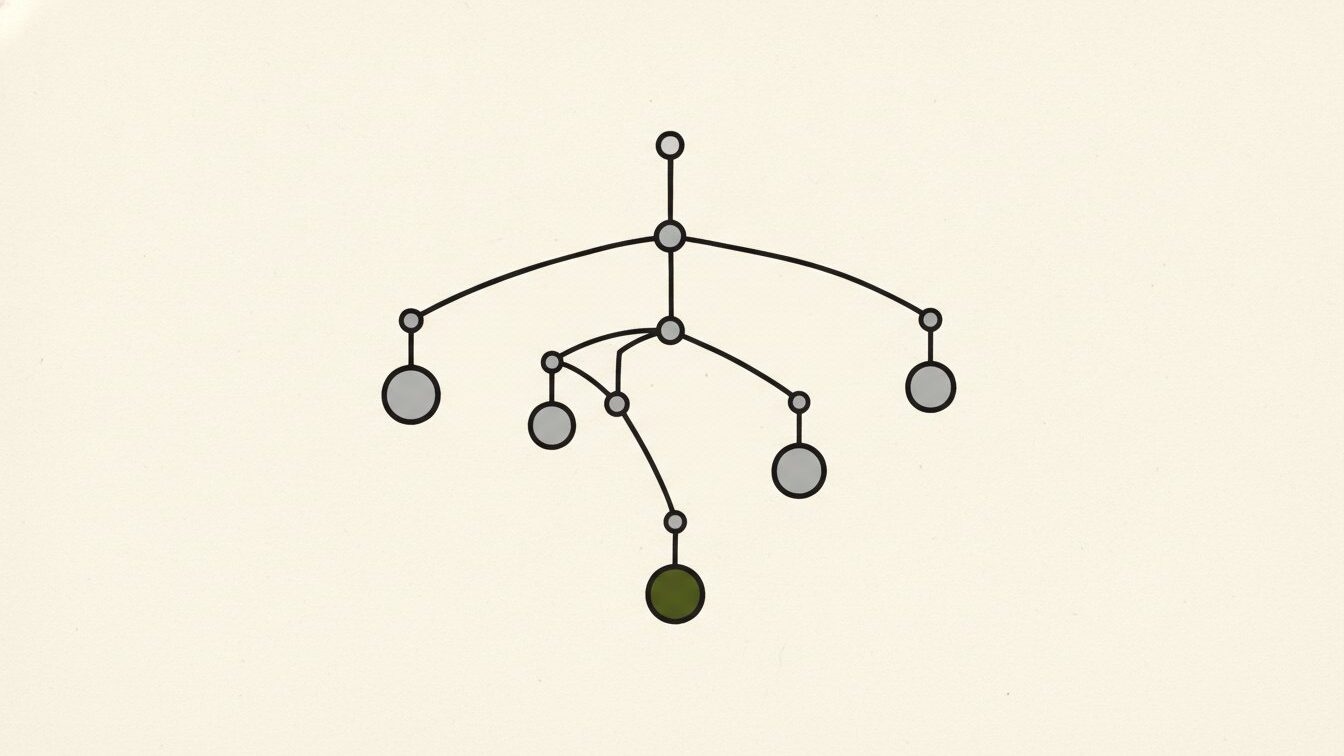
The claim class: an exchange says customer balances are backed one to one by assets it actually holds, and publishes a Merkle-tree proof of reserves so users can confirm their own balance is included in the set the exchange is attesting to.
Claim class: a pattern of statements, not one attributed, dated quote.
Receipt to pull The receipt is the published Merkle root itself, the tool that lets an individual account holder generate a Merkle proof from their own balance and a secret identifier and check that the proof resolves to the published root, plus a dated attestation page stating when the snapshot was taken and, ideally, a separate confirmation of the asset side: on-chain wallet balances (or a third party's read of them) at or near the same snapshot time. No single receipt is linked: this piece explains how to check this kind of claim and does not grade one specific claim.
A valid Merkle inclusion proof shows your balance was counted in the snapshot the root represents. It does not show the exchange's wallets held enough assets to cover that snapshot, it does not show the snapshot reflects today's balances rather than a moment chosen for its optics, and it says nothing about undisclosed liabilities such as a loan collateralized by the same coins being counted as reserves.
Not financial advice. The Crypto Online is a verification desk, not an accredited fact-checker.
“We hold your assets one to one” is one of the most common claims a crypto exchange makes, and one of the hardest for an outside reader to check without help. A Merkle-root proof-of-reserves scheme is the main tool exchanges use to make that claim checkable rather than just stated.
The Claim
The claim class: an exchange says customer balances are backed one to one by assets it actually holds, and publishes a Merkle-tree proof of reserves so users can confirm their own balance is included in the set the exchange is attesting to.
The Receipt
The receipt is the published Merkle root itself, the tool that lets an individual account holder generate a Merkle proof from their own balance and a secret identifier and check that the proof resolves to the published root, plus a dated attestation page stating when the snapshot was taken and, ideally, a separate confirmation of the asset side: on-chain wallet balances (or a third party’s read of them) at or near the same snapshot time.
A root by itself only proves something about the liabilities side, the sum of what the exchange says it owes its users. The exercise only becomes a reserves check once that liabilities figure is compared against an independently observable asset figure, which is why the strongest versions of this scheme publish both sides and a timestamp for each.
What It Doesn’t Prove
A valid Merkle inclusion proof shows your balance was counted in the snapshot the root represents. It does not show the exchange’s wallets held enough assets to cover that snapshot, it does not show the snapshot reflects today’s balances rather than a moment chosen for its optics, and it says nothing about undisclosed liabilities such as a loan collateralized by the same coins being counted as reserves.
How to Check It Yourself
- Find the exchange’s own proof-of-reserves or transparency page rather than a summary written about it, and note the exact snapshot date and time it states.
- Check whether the page lets an individual account holder generate and verify their own Merkle proof against the published root, not just read a headline ratio.
- Look for the asset side: a list of wallet addresses the exchange says are its reserves, ideally attested to by a party other than the exchange itself.
- Open those addresses on the relevant block explorer and read the balance at a block height close to the stated snapshot time, not the current balance.
- Check whether the methodology excludes liabilities that would reduce effective coverage, such as assets pledged as loan collateral elsewhere.
- Treat a single historical snapshot as a point-in-time result; look for a cadence of repeated snapshots before treating the practice as ongoing rather than one-off.
A Worked Example
Picture a mid-sized exchange that publishes a Merkle root alongside a proof tool. A user logs in, generates their own inclusion proof, and confirms it resolves to the published root, so their balance was genuinely counted. Separately, a reader opens the explorer for the addresses the exchange lists as reserves and finds the combined balance across them, at the snapshot block height, comes in below the attested customer total. The individual proof still works exactly as advertised; the reserves side of the same claim is what turns out contradicted, which is why both halves of the check matter, not just the part that is easiest to verify from a single login.
What Supported, Contradicted, and No Receipt Look Like
Supported: The exchange publishes a verifiable Merkle root, a working proof tool, a list of reserve addresses, and the on-chain balance of those addresses at the snapshot time meets or exceeds the attested liabilities, with the methodology disclosing what is and is not included.
Contradicted: The disclosed reserve addresses, read on-chain at the stated snapshot, hold materially less than the attested customer liabilities, or addresses claimed as reserves turn out to be controlled by a different entity than stated.
No receipt: The exchange asserts one-to-one backing in marketing copy but publishes no Merkle root, no proof tool, and no reserve address list; there is nothing for an outside party to check, which is a different and weaker position than a contradicted claim.
Red Flags
- A ratio or percentage is quoted with no link to a root, a proof tool, or reserve addresses.
- The snapshot date is missing or vague, so there is no way to tell how current the attestation is.
- Reserve addresses are disclosed but not attested to by any party besides the exchange itself.
- The methodology is silent on whether pledged or borrowed assets count toward the reserve total.
- There has been exactly one snapshot, published once, with no stated plan to repeat it.
A Practical Complication to Expect
Proof-of-reserves schemes are not standardized across exchanges, which means the same badge can represent very different levels of rigor from one platform to the next. Some exchanges run the check against every asset they list; others limit it to one or two major coins while leaving everything else unaddressed, with the limited scope disclosed only in fine print, if at all. A reader comparing two exchanges’ proof-of-reserves pages should check which specific assets and which specific account types (spot balances only, versus margin, staking, or lending positions as well) are actually covered before treating the two programs as equivalent. It is also worth checking whether the exchange has committed to repeating the exercise on a fixed schedule or whether the current snapshot is simply the only one that has ever been published; a program that ran once during a period of heightened public scrutiny and was never repeated afterward is a materially weaker ongoing assurance than one with a visible history of regular snapshots, even though a single good snapshot is still better than none at all.
Why It Matters
Proof-of-reserves schemes exist because customer trust in a custodian used to rest on reputation alone. A Merkle-root scheme turns a small, falsifiable piece of that trust into something a reader can check without taking anyone’s word for it, which is exactly the gap this desk exists to close.
For the stablecoin version of this same pattern, see our piece on reserve attestations, and for a related but distinct question, see disclosed wallet holdings.
FAQ
Does a Merkle-root proof replace an audit?
No. It is a narrower, cheaper-to-run check of one snapshot of balances against one snapshot of on-chain assets. A full audit covers controls, processes, and a period of time, not a single moment.
Can an exchange fake a Merkle root?
The root itself is just a hash; what matters is whether the exchange also publishes a working proof tool and reserve addresses a reader can check independently. A root with no supporting tool or addresses to check is not a verifiable claim.
What if the reserve addresses hold more than enough, is that proof of good practice?
It is evidence for that one snapshot. It says nothing about whether the same coverage held a week earlier or will hold a week later, which is why repeated, dated snapshots matter more than one good one.
Why does the asset side matter if the exchange already shows my balance was counted?
Because a liabilities-only proof can be entirely accurate about what is owed while saying nothing about whether the matching assets exist; both sides have to be checked for the claim to mean anything.
What should a reader do if the proof tool itself will not run or returns an error?
Treat that as a problem worth reporting rather than a problem to work around; a proof-of-reserves scheme is only as good as the tooling that lets an ordinary user actually run the check, and a tool that is broken, confusing, or requires technical steps far beyond a typical customer undermines the practical value of the whole scheme, even if the underlying math and the published root are entirely legitimate. A well-run program keeps the proof tool simple, documents it clearly, and fixes reported issues with it promptly, which is itself a signal worth weighing alongside the cryptographic result.
Not financial advice. The Crypto Online is a verification desk, not an accredited fact-checker; we describe how a claim like this can be checked, never whether to buy, sell, or hold anything on the back of it.
Sources
This piece links no outside source: it explains a class of claim and the public records you would check, rather than grading one specific statement. When a specific claim is checked, every source link is listed here with its status.
Not financial advice. Human-edited; AI-assisted drafting is disclosed in our editorial guidelines. Spotted an error? See how corrections work.