
MicroStrategy Incorporated (NASDAQ: MSTR) has commanded attention on Wall Street in the last several years, far outpacing its traditional image as a business intelligence software provider. Today, MSTR stock sits at a unique crossroads: its market value now fluctuates not only on company performance but also with the volatile fortunes of Bitcoin. For many investors and analysts, MicroStrategy has become a high-profile play on cryptocurrency adoption—a transformation that redefines both its business risk profile and its reward potential.
As traditional financial metrics and digital asset speculation collide, understanding the drivers behind the MSTR stock price requires a nuanced look at the company’s operational fundamentals, Bitcoin strategy, and broader market sentiment. This article delves deep into MicroStrategy’s share value, examining performance trends, investor sentiment, and the evolving thesis that sets MSTR apart from its software peers.
MicroStrategy’s Core Business: Still Software, Yet Overshadowed
Founded in 1989, MicroStrategy long built its reputation on analytics, mobile software, and cloud-based business intelligence products. The company serves a diverse roster of enterprise clients, focusing on helping businesses make data-driven decisions. Historically, revenue growth and profitability in this sector have driven the company’s valuation—similar to other software-as-a-service (SaaS) providers.
Yet, over the past few years, software revenue growth has been steady but unspectacular relative to industry leaders. According to recent reports, the company’s core business remains profitable but represents a shrinking share of its market narrative. Quarterly earnings continue to highlight recurring client contracts and enterprise adoption, yet these are often eclipsed by news of the company’s next Bitcoin purchase or digital asset accounting update.
Key Metrics for the Software Segment
- Recurring revenues from cloud and support services form the backbone of operational stability.
- Gross margins in the software business typically remain healthy, often exceeding industry averages.
- Innovation in AI-driven analytics and new product rollouts persist, but market traction faces intense competition from giants like Salesforce and Microsoft.
While these fundamentals anchor some investor confidence, they are increasingly overshadowed by the company’s dramatic cryptocurrency strategy.
Bitcoin as the New Business Pivot: A Market-Altering Strategy
The true inflection point in the MSTR stock price narrative began in August 2020, when CEO Michael Saylor announced MicroStrategy’s decision to make Bitcoin its primary treasury reserve asset. Since then, the company has purchased billions of dollars’ worth of Bitcoin, financed both by free cash flow and large-scale convertible note offerings.
The impact was immediate. MSTR stock started trading less like a software company and more like a proxy for Bitcoin exposure—attracting a new universe of retail and institutional investors. Volatility soared accordingly, mirroring the ups and downs of the leading cryptocurrency. This strategic pivot has been praised as bold and forward-thinking by some, yet criticized as dangerously speculative by others.
“MicroStrategy’s share price now acts as a high-beta Bitcoin ETF—with operational cash flows from enterprise software essentially underwriting leveraged crypto exposure,” notes a senior equity analyst at a major U.S. investment bank.
The Scale of MicroStrategy’s Bitcoin Holdings
- As of early 2024, MicroStrategy owns one of the largest public company Bitcoin treasuries worldwide, measured in the tens of thousands of coins.
- Regular disclosures keep investors informed about acquisition costs, unrealized profits or losses, and potential market risks.
- Each new Bitcoin-related headline reliably generates outsized stock price movement, regardless of software performance.
MSTR Stock Price Performance: Trends, Volatility, and Catalysts
Historical Price Action & 2020 Onward
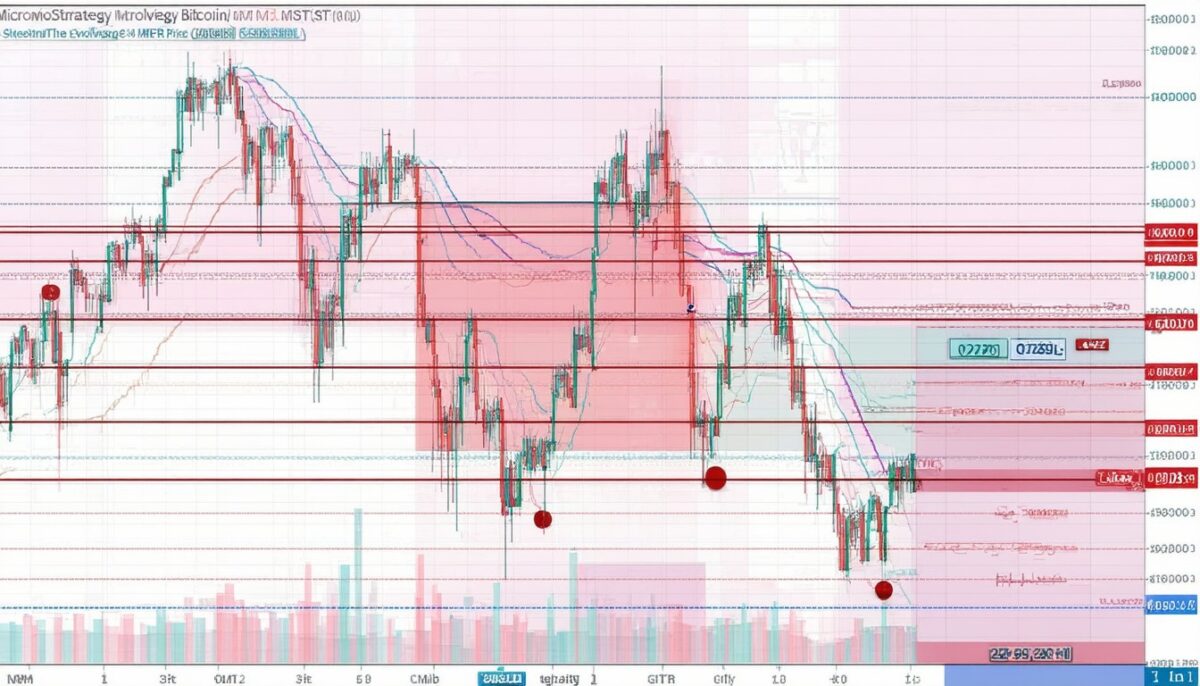
From 2017 to mid-2020, MSTR traded primarily in correlation with other enterprise SaaS players. However, the Bitcoin shift transformed its trajectory. During bull markets in cryptocurrency, MSTR often posted multi-fold gains, with surges tied directly to bullish moves in Bitcoin.
Conversely, the stock suffers during “crypto winter” periods, when digital asset prices retreat or regulatory crackdowns intensify. This has made MSTR one of the most volatile large-cap stocks on the NASDAQ—a profile only partially mitigated by core business stability.
Real-World Example: 2021–2022 Volatility
In 2021, as Bitcoin reached new all-time highs, MSTR’s market cap ballooned, with some trading days seeing double-digit percentage swings. In 2022, when crypto markets retrenched, MicroStrategy’s valuation similarly fell, reflecting significant mark-to-market losses on its treasury asset.
This price action attracted hedge funds, momentum traders, and even options market participants—not the typical audience for an enterprise software stock.
Key Catalysts and Share Price Drivers
Several factors now exert outsized influence on the MSTR stock price:
- Bitcoin price movements: The single greatest external input.
- Regulatory headlines: U.S. SEC decisions, proposed Bitcoin ETF approvals, or accounting rule changes move the shares.
- MicroStrategy’s buying/selling signals: Large Bitcoin transactions (disclosed via SEC filings) cause immediate reaction.
- Software earnings surprises: While occasionally positive, these now play a secondary role compared to Bitcoin dynamics.
Risks and Opportunities: Balancing Innovation with Volatility
MicroStrategy’s approach is not without intense risk:
- Leverage risk: Financing Bitcoin purchases with debt amplifies potential returns—and losses.
- Regulatory uncertainty: Shifts in the U.S. or global stance on digital assets could destabilize balance sheet value.
- Accounting and impairment risk: Current GAAP rules force companies to recognize impairment losses on Bitcoin, even if those losses are unrealized.
Still, for some investors, MSTR remains a uniquely leveraged play on digital asset adoption. Others maintain confidence in the company’s base software business, believing that Bitcoin exposure simply adds optionality.
Institutional and Retail Investor Sentiment
Many large funds trade MSTR as a proxy for Bitcoin, at times treating the shares as a liquid, U.S.-regulated alternative to holding Bitcoin outright. Retail investors, meanwhile, are often attracted to the stock’s potential for explosive upside and media attention, with social sentiment playing a key role in short-term price swings.
The Future Outlook: What Could Redefine Share Value?
Looking ahead, MSTR stock price will likely continue to fluctuate based on both the evolving regulatory environment for cryptocurrencies and the company’s agility in maintaining core software competitiveness. The advent of spot Bitcoin ETFs and changing U.S. accounting rules could further reshape the investment case for MicroStrategy, possibly smoothing volatility or opening new sources of institutional demand.
Meanwhile, any move by MicroStrategy to hedge, diversify, or even reduce its Bitcoin exposure would dramatically alter the risk/reward equation for shareholders.
Conclusion: Navigating Complexity in MSTR’s Market Narrative
MicroStrategy’s share value now sits at the confluence of two powerful themes: enterprise technology and the disruptive rise of digital assets. For investors, the MSTR stock price offers both a cautionary tale about company-level risk taking and an example of bold strategic pivoting in the face of changing financial paradigms.
Understanding MSTR’s investment thesis requires a clear-eyed view of both industry fundamentals and the unpredictable nature of global crypto markets. Those weighing an investment must be prepared for above-average volatility—but also for the possibility of outsized returns, should the company’s dual strategy succeed.
FAQs
How does MicroStrategy’s Bitcoin strategy affect its stock price?
MicroStrategy’s heavy investment in Bitcoin means its stock price often rises and falls in tandem with cryptocurrency markets. Many investors now view MSTR as a proxy for Bitcoin exposure—not just a software company.
What are the core risks of owning MSTR shares?
Major risks include Bitcoin price volatility, leverage from debt-funded purchases, regulatory changes, and accounting rules that can magnify reported losses or gains.
Does MicroStrategy still generate revenue from its software business?
Yes, the company continues to serve enterprise clients with business intelligence and analytics products. However, this core business now plays a secondary role in driving the stock price.
Can MSTR be considered a safe investment?
Due to its leveraged exposure to a highly volatile asset class, MSTR is generally considered riskier than traditional technology stocks. Investors should carefully assess their risk tolerance before investing.
How does MSTR compare to buying Bitcoin directly?
Holding MSTR provides indirect exposure to Bitcoin plus added company-specific risks and potential rewards. Unlike direct Bitcoin ownership, MSTR also includes operating business performance and is subject to stock market regulations.
What could change the market perception of MSTR stock?
Factors like significant regulatory developments, spot Bitcoin ETF growth, changes in accounting rules, or a strategic shift in MicroStrategy’s approach to its Bitcoin holdings could all significantly alter investor sentiment and the stock’s volatility.